Featured

Introduction

Welcome to my Choose Your Own Adventure story! This project was created to explore elements of collective authorship and multimodal means of displaying information. I came up with the idea for this story by incorporating unwitting participation and using the above picture to prompt the plot.

To read the story, simply click the hyperlink of your choice in each section and you will be taken to the next part. To start at the beginning, click the hyperlink below.

Enjoy!

Graded Blog Post #10

I have really enjoyed taking this class this semester. Exploring different forms of media has opened my eyes to the possibilities of creative works which I very much appreciate as a creative writer. I always thought text, image, and sound were separate ways of communicating, but through this class I have come to see them as tools that can be used in conjunction with each other in very effective ways, and that memes, podcasts, social media, blogs, and video games can be very impactful in creating meaning and inspiring action.

My favorite assignment was the Collaborative Composition and Analysis piece. I had so much fun playing with different forms of participation, a new genre of story (horror), and a new kind of story (Choose Your Own Adventure). Since I am majoring in Creative Writing, I was very grateful for the chance to apply what I had been learning in this class to my area of study when writing the story.

Similarly, I really liked writing the personal manifesto. At first I was reluctant to do it and did not think it would turn out well, but since this is a New Media class I thought of trying to make mine in a different way than just bullet points or a simple “this is what I believe” statement. Instead, I wrote it as a poem (also outside of my comfort zone since I consider myself a short story-writer/novelist instead of poet) and I am very pleased with the outcome. Again, I toyed with a familiar medium (poetry) and added elements of new media like images and hyperlinks and really enjoyed the process and am happy with the result.

I did not really like the reaction paper we wrote a few weeks ago, since I am writing plenty of papers in my other English classes. I thought in a class about new media where we were creating a blog I would not have to worry about academic papers, so I was disappointed when that one came around. I really enjoyed the article it was about too, but then analyzing it and coming up with an argument took the joy out of it for me and made me feel as though I was just in any other literature class. It was hard for me to benefit from that assignment, since it felt the same as every other English assignment I have had since high school.

Overall, I am glad I took this class to fulfill one of my major requirements. The subject matter was especially interesting since our world is increasingly dominated by technology and new ways of presenting information. Each assignment was different in some way that made me excited to tackle it. I really liked the online discussions on Fridays since it gave me time to gather my thoughts and present them in the best way rather than spitting them out half-formed in an actual classroom. Throughout the semester, I learned a lot about how to communicate ideas effectively and am excited to take those lessons beyond this class.

Graded Blog Post #9

The Future of Reading

Literature will always be important to society. It influences us and guides our decisions, both from the shadows and in the light. There is no denying the impact that literature in any form has on humanity, but it is undeniable that the written book is one of the most effective means of using literature. It allows for in-depth development and analysis of a topic that allows for many different interpretations. Books let people from all backgrounds and walks of life come to their own conclusions about important issues that need to be addressed in many different genres and forms (fiction, non-fiction, poetry, sci-fi, fantasy, romance, thriller, drama, mystery, horror, etc). In our growing age of technology, however, books are becoming less common in favor of other means of delivering information, such as eBooks, online articles, podcasts, videos, memes, and social media posts. Video games, TV shows, movies, and social media have come to take up the time that used to be spent reading. The question–one that should be interesting to scholars, writers, and readers alike–is, will book-reading one day vanish completely?

As I conducted my research, I was surprised to learn that the general consensus is that print books, and therefore reading itself, are far from being in danger of dying out. An article by Kristen Ludwigsen described her debut into the publishing industry and her (and her family’s) fears that the industry was shrinking and pointless to join. She found that the publishing industry has simply adapted with the times and adopted audiobooks and eBooks to expand accessibility. Celebrity book clubs are making a comeback and book sales across many genres are increasing, including juvenile and young adult fiction, which is encouraging to hear since children have much easier access to the distractions of technology than they ever have before. Print books still outsell eBooks, and audiobooks provide an easy way to keep reading while on road-trips or doing menial tasks. Despite so much availability of technology and alternatives to books, they are continuing to thrive.

In fact, most articles agreed that while eBooks are becoming popular because of their ease of access, the majority of people still prefer print books. The article Stop Saying Books Are Dead. They’re More Alive Than Ever was written by Lisa Lucas, who believes that whenever someone says books are dying, that proves that they would like to be convinced otherwise which is what Lucas is there to do. Lucas uses facts to back her argument, saying that a study found that 24% of Americans did not read a book in 2017, which means that 76% did. A quarter of the country may have abandoned reading, but three quarters of it still holds on strong. The American Booksellers Association, for example, said in 2018 that its membership grew for the ninth year in a row. Despite the prevalence of eBooks, physical book sales continue to grow every year. The article Paperback vs Ebook: The Best Of Both Worlds by André Klein mentions how eBooks are popular because they tend to be cheaper (and available to read much faster since there is no need for shipping), but he also points out that only 2% of sold books in Germany are eBooks, with 12% in the UK and 25% in the US. That is still a very significant amount of sales going towards regular print books.

It is easy to see why books are so popular. The article 5 Reasons Why Books Aren’t Dying Out captures the feel of reading in the quote “Reading a well-written book you are instantly transported to a completely immersive world full of color, texture, shapes, smells, sounds, feelings and relationships . . . And, while the plot, characters and dialogues are fixed by the author, it’s the reader who creates this world in his mind.” While eBooks do not get rid of this intimacy and imagination, sometimes they can take away from it, especially if the digital version elects to include photos and thereby contradict the idea in the reader’s head. The human mind creates images that are unmatched by any technology, which is why many people prefer books over their movie counterparts if they have been adapted into film. The article, also written by André Klein, goes on to say that the print book as we know it may evolve into something more, but nothing will ever truly replace the stories that print books tell. In his article The Death of Print Doesn’t Have to Mean the Death of Publishing, Steve Haber rightly says that “in a world of social networks, video games and mobile handsets that do everything imaginable, Americans have maintained their interest in reading.”

Of course, there are some who believe that reading itself does have an expiration date. Haber’s article, while it focuses on the ways publishing is still thriving, does mention how it could still vanish if publishers are not careful. Some publishing companies are refraining from publishing content as eBooks, which alienates loyal customers that have already started adopting the new technology. This encourages piracy, which could mean the end of the publishing industry if publishers do not catch on. A New York Times article further discussed the possible death of reading, pointing to the belief that the radio would kill reading when it was first introduced. In 1966, some people equated books with antiques like clotheslines and stocking seams. Many futuristic dreamers and writers believed that bookshelves would be a thing of the past.

It was surprisingly difficult to find people that truly thought books were disappearing. Most articles that argued that books were dying were very old and therefore obsolete. The essay The End of Books by Robert Coover demonstrates the author’s view that books will soon be gone, but it was written in 1992 and things have changed drastically since then. With the rise of different technologies that present different ways of reading, books are more popular than ever. As Lisa Lucas said, “Storytelling is fundamental to human beings. It is how we explore and make sense of this world and understand one another.” To lose books would be to lose a vital form of communication and tool for growth, so it is comforting to hear that reading is not dying out like some may think.

When I initially approached the topic of books and their prevalence today, I thought many people would say that books are vanishing. In my experience, it has felt as though no one reads anymore and instead spends all their time on YouTube, various social media platforms, or streaming services like Netflix. I thought I was a member of a very small club of people my age that still sought out books for entertainment rather than (or in addition to) movies and TV shows. Once I really started exploring the question, however, I found that to be far from true. So many people are still reading as many books as they can get their hands on, just in different formats. While I will never stop reading print books, I myself love eBooks because of the ability to take them with me almost anywhere, especially when it comes to big textbooks for school. Lots of people enjoy audiobooks during work commutes, road-trips, workouts, or even in the kitchen while cooking. There are many different mediums through which people read, but reading itself is not going anywhere anytime soon.

This is the subject I would like to explore for my final multimodal project. My question is whether or not book-reading is relevant to our society today, and I believe that it still is. The research I have done supports this claim, but I will also look harder for the initial idea that reading is disappearing and why people think so in order to discuss both sides of the question. I will most likely do this as a website, but I have not settled on a host yet. I have never used wix.com before, but after using WordPress the entire semester, I am eager to try something new. My plan is to include a few pages describing the purpose of the website and my perspective on the matter, with different sections providing the facts that back my argument. One section will focus on the rise of eBooks and audiobooks and how they have affected the publishing industry in regards to price, availability, and interest. Another will discuss social media, video games, and streaming services and the impact those have had on reading. I am interested to continue exploring this topic and excited to see where it will take me.
Graded Blog Post #8

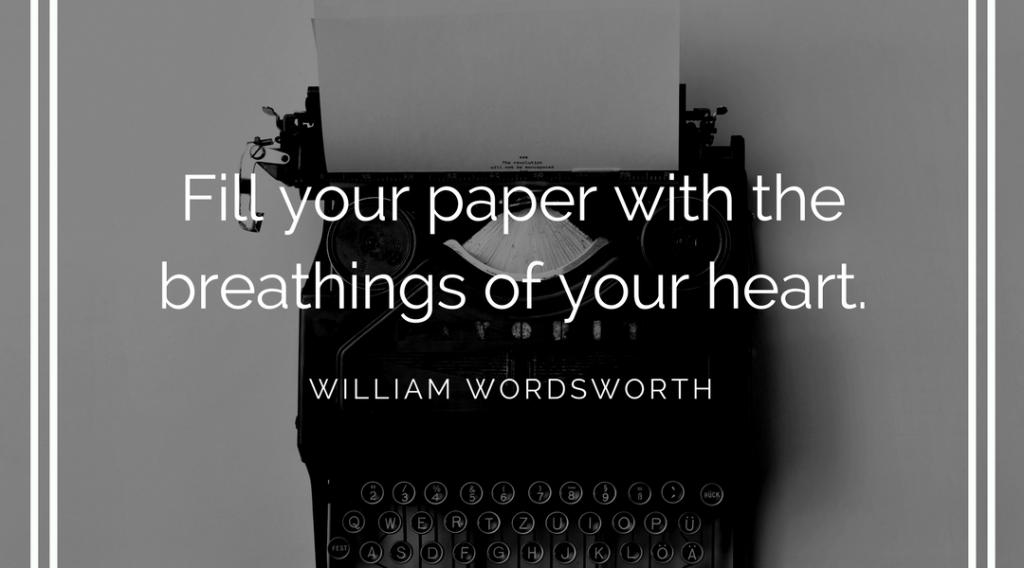
http://yourartsygirl.blogspot.com/2018/02/breathings-of-your-heart.html

not all writers are poets.

not all poets are right.
your work doesn’t have to have a meaning
to be meaningful. it’s yours. when you write
you write for you. others may like your work
but that’s not the point. you write to have fun.
you write to enjoy life. you write to feel. you write
to explore. you write the thing you wish someone else
had written years ago when you first began reading
and wanted more.
it’s okay to use clichés. it’s okay to cause pain
it’s okay to hurt the reader. it’s okay to write
a sad ending. it’s okay to write a female
knight in shining armor and a dude in distress.
it’s okay to stray from “they lived happily ever after.”
it’s okay to be ambiguous. and it’s okay that creative
work often necessitates artful language and structure but
sometimes not.
independent clauses are nice but so are dependent clauses.
there is a time to stop and there is a time to go. there is a time
for more and there is a time for less. you should never write
“no” when you can write “yes.”
and.
and you must always be ready to hand over the keys of the car.
Make the plan. Execute the plan. Expect the plan to go off the rails.
Throw away the plan.
” the work is yours, but it also belongs
to itself. don’t force it to be something it’s not. not every character
must change. change is something that happens, not something
you do. but what you do is answer questions. you offer an escape.
you offer peace.
What you do is create a new world.

https://www.artsy.net/article/artsy-editorial-8-things-creative

Graded Blog Post #6

Reaction to Bogost

Video games have become increasingly popular in the past decade or so. They allow players to learn, create, or simply distract themselves. Ian Bogost’s paper “The Rhetoric of Video Games” addresses the different purposes video games can serve and the merits each one possesses. Bogost stresses that we must examine video games with a critical eye to determine their underlying meanings and how they function in our society. It is clear that video games often serve more than one purpose, but I do not think it is necessary to go digging for those meanings. 

Bogost’s paper mainly focuses on the lessons video games pose. According to him, his first example, the game Animal Crossing, demonstrates a link between debt and acquisition in the real world. The player’s main focus in the game is upgrading and paying off their house, which is something we can easily relate to. The problem is, the more the player pays off their debt, the more they can upgrade their home and buy more products, which makes them need to pay off their debt again. As Bogost says, “buying more living space not only creates more debt, it also drives the impulse to acquire more goods. More goods demand even more space, creating a vicious cycle.” This is a very valid point he makes, but for most players it is probably the farthest thing from their minds. The players are only interested in playing the game, whether it is to pass the time, distract themselves, or simply because they enjoy living another life in the digital world. So while Bogost is correct in pointing out the correlation between the game and the real world, that connection was probably made to invest consumers in the game and keep them playing it, rather than to teach them about how the world works. The lesson is just a hidden bonus, and because of its subtlety, we do not need to dwell on it too much. By presenting the lesson in a game, we slowly absorb the message and internalize it without the need to go searching for it, unlike Bogost’s suggestion. 

In contrast, the other games Bogost detailed such as America’s Army: Operations and Take Back Illinois were clearly made to promote a specific idea or purpose. America’s Army was designed to generate interest in joining the US Army by giving players a sense of how the army works, almost up close and personal, and begin instilling the Army’s desired traits in them (following orders, relying on teamwork, etc.). Take Back Illinois was commissioned in 2004 to educate voters on public policy issues in the upcoming election. Its purpose was to present the information in an engaging way that allowed players to understand the policies. For both America’s Army and Take Back Illinois, the element of fun was an added perk. Their existence was meant to educate and teach, but their method of presentation allowed them to be enjoyable experiences that made them reach wider audiences. In that way, it is unnecessary to go looking for the meaning and the fun within those games, making Bogost’s argument obsolete. 

Some other examples of video games meant to teach that Bogost did not mention include the typing games created when computer became more popular and accessible. I still remember playing those games to learn how to most efficiently type on a computer, but it never felt like work or a task I had to complete. It was fun game that happened to teach me how to type at the same time. Likewise, the Nintendo Wii game Wii Fit is meant to promote health and fitness as desirable hobbies for players. To do that, the creators made fun games that players enjoy playing, so that it feels less like a dreaded workout. Under the same umbrella of following multiple agendas, the Nintendo Wii game series Just Dance mostly serve to entertain the player(s). Music is all around our society and oftentimes contagious, so it is not surprising that people would jump at the chance to play a game and follow choreographed dance moves to some of their favorite songs. Underneath the surface, however, these games also prompt active lifestyles. When dancing enthusiastically and vigorously, the action can be an intense workout, so almost without realizing it, the players are being nudged toward being healthier. Both of these video games are very subtle in their agendas while still retaining their meaning and importance, so it does not seem necessary to critically analyze them like Bogost wants to. 

Bogost’s paper brings up interesting points about each of the video games he addresses and the deeper meanings they convey. He says we must “learn to play critically, to suss out the meaning they carry, both on and under the surface,” but that is not always the right approach. When we go looking for meaning or something deeper, we encounter resistance or confusion. Instead, if we let it be and enjoy the experience of playing these video games, we will understand the messages they convey without that additional effort that causes problems. In some instances, analyzing video games may be necessary to really squeeze out every drop of meaning, but most of the time it is not required. Whatever the case, video games cannot simply be called distractions and things to be grown out of. Besides, many other forms of media may seem at first glance to be only entertainment—like books and movies—but simultaneously convey deep themes and messages. That fact has already been recognized in these mediums, however, which is the main difference between them and video games. What should happen is that we should normalize video games and the impacts they can have on our lives, instead of treating them as a something to be looked down upon when they are in fact on the same level as those other forms of media. Overall, I think this is what Bogost is trying to share in his paper. 

A Sinister Sunset

https://rootsrated.com/stories/7-most-stunning-sunset-hikes-around-knoxville

The sunset is one of the prettiest you have ever seen. The soft orange, yellow, and faint red blend together sweetly, sending a wave of calm over you as you admire it. This is one of the reasons you love biking around town in the evening, to enjoy the sunset. Out of all the places you’ve lived, you’ve never seen sunsets like the ones here in Phoenix, Arizona. That is why you’ve lived here for so long. 

You forgot your headphones at home, but you don’t need them. The atmosphere is soothing, and there are very few cars driving along the dirt road you follow. Rocky hills surround you, but in the distance the rocks morph into a dense forest. The temperature is cold enough that the heat you generate while biking is welcome, and you are comfortable. You are miles away from your house, about to reach the point in your ride where you will turn around and head home. 

A Prius passes you and you nod amiably at the driver, and the middle-aged man nods back. You both continue to your respective destinations, the driver vanishing in the distance. 

Just as you are about to turn around, you hear another bicycle coming up behind you. You move to the side and slow down to let them pass, but what you see makes you stop in your tracks. 

https://www.everywritersresource.com/10-horrifying-horror-story-prompts/

A skeleton bikes past you, pedaling steadily. Its long arms rest on the handle bars of its bike, leaning over them. Wind whistles through its ribcage, a sound that raises the hair on your arms. There is not one flap of skin anywhere on its frame, its eye sockets, nose, and mouth completely empty. The sun’s disappearing rays shine through the gaps between its ribs and the gaping holes in its skull. Its bones and joints creak as it moves, but otherwise it seems to be very much alive. 

The skeleton looks at you as it bikes by, opening its mouth in what you can only guess is supposed to be a smile. You recoil, but the skeleton doesn’t notice and continues on its way, advancing with surprising speed. 

For a moment, you stand with one foot on the ground to prop yourself up as you stare at the shrinking skeleton. Everything in you is screaming at you to call a friend, the police, someone, anyone, and tell them what you have seen. But even as the skeleton gets farther away, you feel the urge to go after it. 

You can either: follow the skeleton or go home

Follow the Skeleton

Your entire body screams at you to turn around and go home, but instead you get back on your bike and pedal fast, following the skeleton. The rocky desert area transforms into a sea of wood. Besides your breathing and the creaking of your bike, the only sounds are the faint chirpings of birds and crickets. 

You can barely make out the faint form of the skeleton a few hundred feet in front of you, just close enough for you to continue following it. Eventually, you lose sight of it and after a few feet, you understand why. 

The road you have been following now splits into two smaller lanes, just big enough for a car, and you stand at a crossroads. Both roads continue into the forest. It looks as though the right lane may have been used recently by a cyclist—perhaps the skeleton you have been following—but it is difficult to tell. The left lane holds no indicators of any kind. 

https://www.flickr.com/photos/laenulfean/5943132296

Which way do you go: left or right

The Left Path

You choose left and continue down that path. You are still surrounded by trees on all sides, but the road starts curving left. You follow it, curious as to what you will find. You haven’t heard of any roads in this area before, not even from your friend Wanda who is always going on hikes and exploring nature. 

After pedaling for about five minutes, the road merges with another and you continue straight. Certain trees and rocks start to look familiar, and then you end up at the same crossroads you were at before. You have gone in a circle. You have no choice but to go right

The Right Path

You go down the path on the right, following the faint line in the dirt left by what you assume was the skeleton. You bike for about fifteen minutes without any sign of intelligent life. The line in the dirt does look more prominent, though, and you are almost sure this is the path the skeleton followed. 

You pedal for another ten minutes, and just as you are about to give up and turn around, the road opens into a clearing. Instead of trees as far as the eye can see, the road ends at the mouth of a clearly abandoned mineshaft. A single oil lamp hangs at the entrance, illuminating it enough for you to see the cart tracks laid into the ground that lead deep into the mine. An old cart sits just outside the entrance, a surprisingly new-looking sign leaning against it that simply reads “Enter.” As you reach the end of the road, you see the skeleton again. It disappears just as quickly into the mine. 

https://www.summitpost.org/spruce-mountain-mine-shaft-entrance/440017

You slow to a stop and then struggle to keep from falling as your back tire bursts. A particularly sharp rock sticks out of the rubber and you mutter a few curses. Your bike is useless until you can get a new tire, and you are an hour away from any type of civilization. 

You drop your bike and pull out your phone and curse again when you see that it has only ten percent battery. Of course, today of all days you forgot to charge it before going out. 

The phone only has enough battery for one task: a call for help, or to use as a flashlight while exploring the mine

Design a site like this with WordPress.com
Get started